
Leftovers from the Memorial

Another brick pulled from the Tower
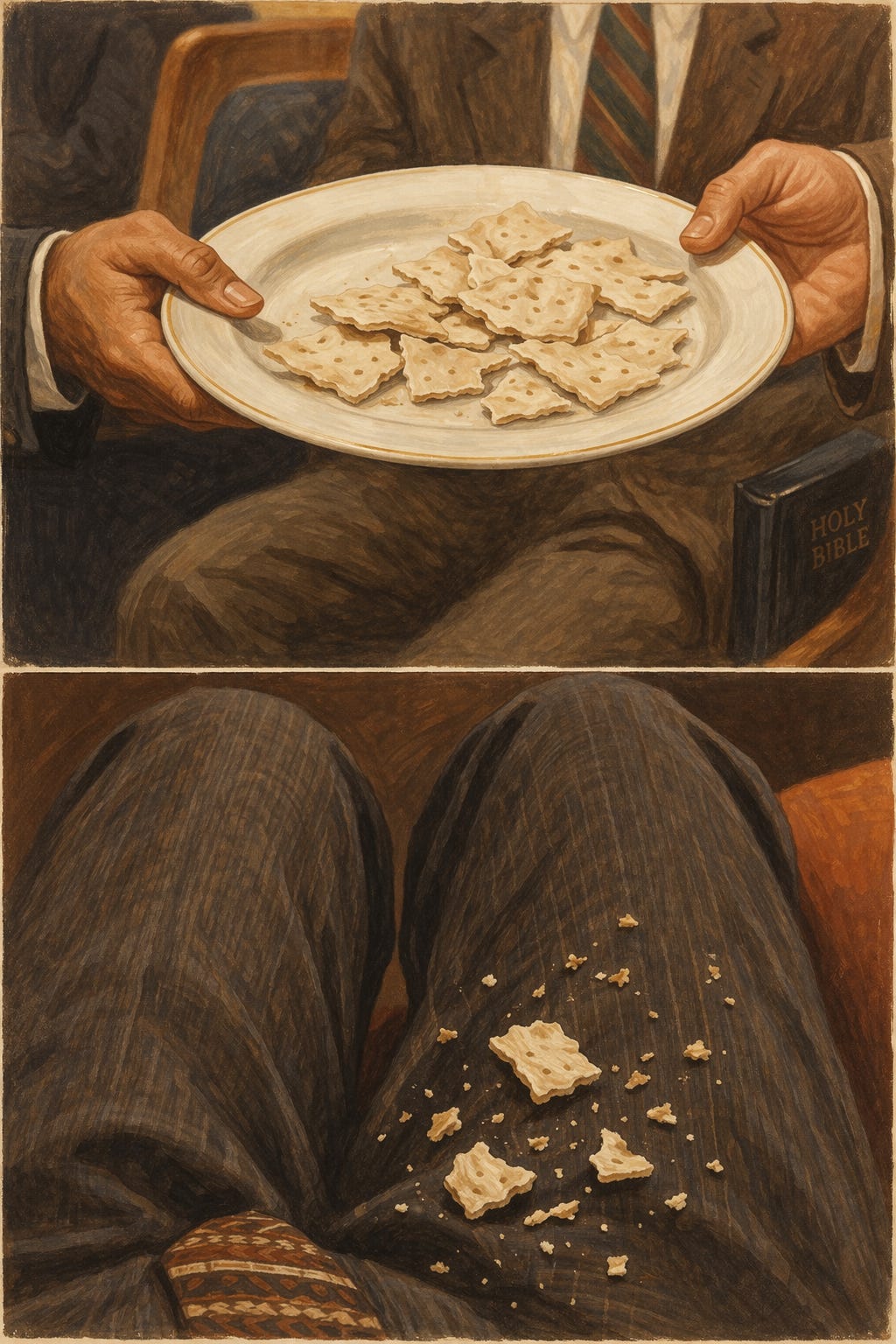
Every year the same theater returns.
A ritual about fulfillment. A speech about promises. A sales pitch for “future blessings” still sitting in a warehouse somewhere. And sooner or later the speaker reaches for Isaiah 65. Houses. Vineyards. Long life. Peace. The glossy brochure of paradise.
There is a problem with using old promises as bait for future certainty.
They were promises to ancient Israel.
Not in a soft, sentimental way. In the blunt, obvious way. A prophecy aimed at a people in history, with covenant language, land language, restoration language, and national hopes. Not a spiritual coupon floating through time, waiting for a Watchtower outline to redeem it.
And worse — even on its own terms, the passage does not say what they want it to say.
Isaiah 65:20 is the loose floorboard.
Read it straight:
“No more shall there be in it an infant who lives but a few days, or an old person who does not live out a lifetime; for one who dies at a hundred years will be considered a youth, and one who falls short of a hundred will be considered accursed.”
No more infants dying young. Beautiful. Then the picture rolls out: houses built and lived in, vineyards planted and enjoyed, labor not stolen, children not born for calamity, wolves and lambs feeding together, God close enough to answer mid-sentence.
But read verse 20 again.
Dies at a hundred.
Considered accursed.
That is not immortality. That is long life with death still in the room. Still part of the furniture.
So the believer has a choice. Not a good one. Just the usual one.
Either the text means what it says — death is still part of the scene, and the paradise brochure has a printing error.
Or the text becomes metaphor the second it causes trouble.
The houses are literal. The vineyards are literal. The wolf and the lamb are literal enough to end up on a tract cover. But the death part? Ah. Poetry. Symbolism. Ancient imagery. Don’t be wooden, brother.
Funny how the verse turns figurative exactly where doctrine starts sweating.
P1. A text should be interpreted by a consistent method.
P2. Isaiah 65 is treated literally when it describes houses, vineyards, offspring, and animal peace.
P3. Isaiah 65:20 is treated non-literally when its literal sense includes death in the restored age.
C. The interpretation is inconsistent.
Once the method breaks, the sermon is running on fumes.
Because the deeper problem is not only that Isaiah 65 doesn’t cleanly teach paradise. The deeper problem is that these are supposed to be the blessings the Messiah already brought.
That was the pitch.
Restoration. Peace. Security. No more crying. No more distress. God rejoicing in Jerusalem. Answering before they even call. Life put right.
And yet here we are. Two thousand years after Jesus, still burying children, still aging, still sweating, still waiting for men in suits to explain why the real fulfillment is always just around the corner.
That is not fulfillment. That is deferral with a necktie.
P1. The Messiah fulfilled the promises.
P2. The promised conditions never arrived.
C. Those claims cannot both be true.
You can soften the wording. Stretch the timeline. Say “already but not yet,” “future phase,” “new light” — whatever theological air freshener is on sale this week. But the smell remains.
A fulfilled promise that has not happened is not fulfillment. It is delay. And delay is the native language of failed prophecy.
P1. Isaiah 65 is used as a literal preview of future earthly life.
P2. In that same preview, people still die.
P3. Watchtower teaches that faithful humans in paradise will live forever.
C. Isaiah 65 does not describe Watchtower’s paradise.
This is where they reach for mystery. Or timing. Or layered fulfillment. Or Jehovah will clarify matters in due time.
He always does. Right after the contradiction gets spotted.
Honest reading is less glamorous. Maybe the text was for Israel. Maybe it reflected real national hopes — a people replanted in their land, their labor finally their own, their children surviving. Maybe later readers stretched it over doctrines it was never built to carry. Maybe “future blessings” are just old promises kept on life support because the institution needs them breathing.
That possibility terrifies control systems. Because once you see that the brochure was patched together from unfulfilled pieces, something shifts.
The Memorial changes.
It stops feeling like sacred certainty.
It starts feeling like a meal served in the ruins of a failed argument.
The real leftovers are not bread. Not wine. Not crumbs on a plate.
Leftover promises.
Leftover explanations.
Leftover certainty — reheated for another year.
You don’t have to be a Jehovah’s Witness to recognize the pattern. Every system built on deferred promises works this way. Fulfillment is always near. Explanation is always ready. Questions are always premature.
But the text is still there. Verse 20 is still there.
Dies at a hundred.
Considered accursed.
Read it. Think about it. That is all this asks.
Deconstructing the Tower explores the logical and scriptural foundations of Jehovah’s Witness doctrine — one brick at a time.