
Revelation Was Never About You
Article 5 — The Case Against Watchtower. Why the Watchtower needs you to think it is.

The Watchtower wants you afraid.
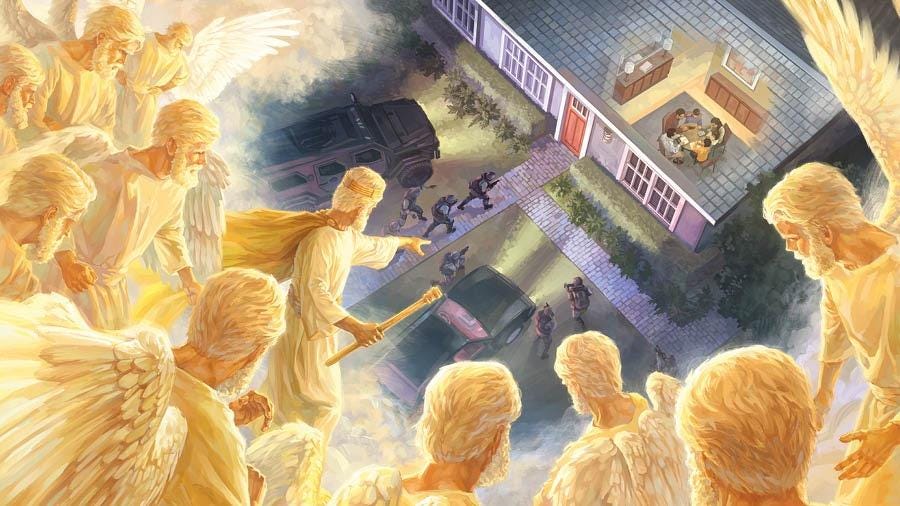
Not in a vague way. In a calibrated, scheduled, cited-with-paragraph-numbers way. Open any WT publication from the past several decades and you’ll probably find the same engine running: a harlot, a beast, a sudden turn, a fire, a great tribulation, a global mass destruction. The world’s governments will rise up and destroy false religion. Then God finishes the job. Then the survivors — coincidentally, the people holding the pamphlet — inherit a paradise earth.
It’s a hell of a sales pitch. It also has nothing to do with what Revelation actually is.
Revelation is a first-century document, written by a first-century Jewish Christian, for first-century churches, about a first-century empire. Just look at Revelation 1:4 and it tells you who this is for: “to the seven churches that are in Asia.” So why would I think this is about anyone anywhere else? It is soaked in the politics, paranoia, and dark satire of its moment. It names names — in code, because John would’ve been crucified otherwise — and the names it names are dead. The empire it cursed fell. The emperor it caricatured rotted in a tomb on the Pincian Hill. The fire never came for you because the fire was never aimed at you.
You were never the audience. You were never the target.
Revelation opens with “what must soon take place.” It closes with “I am coming quickly.” In between, again and again, the time is near. Not near in geological time. Near in the sense that the people reading the letter expected to see it happen. John was not writing a coded message for Americans with 5G. He was writing an urgent warning to people he knew by name. Every modern reading that pushes the fulfillment two thousand years downstream has to override the book’s own clock.
And once you see that, the fear evaporates.
What Revelation Actually Is
Start with the genre. This matters more than anything else, and Watchtower will never tell you, because the genre alone is enough to dismantle the whole system.
Revelation is apocalyptic literature. Not “apocalypse” in the modern sense — explosions, asteroids, Nicolas Cage. Apocalyptic in the ancient sense: a coded political tract written under imperial occupation, dressed up in cosmic imagery, addressed to a small persecuted community, designed to say the empire will fall and we will be vindicated without getting the author murdered.
Daniel did it under the Greeks. 1 Enoch did it under the Hellenists. 4 Ezra did it after the Romans burned the temple. The Sibylline Oracles did it in fragments across centuries. There were dozens of these books circulating in the first century. Revelation is one of them. Most of them didn’t make the cut for the New Testament. Revelation barely did — early church fathers debated for centuries whether to include it, and not because of hellfire.
The genre has rules. The genre runs on symbolism. Literalism is the last tool you reach for, not the first. The point is to encode a present-tense political situation in language that the in-group can decode and the out-group cannot.
The New Oxford Annotated Bible spells it out: Revelation’s imagery draws on Isaiah, Ezekiel, Daniel, Jeremiah — earlier apocalyptic and prophetic literature aimed at earlier empires. John is recycling. He’s not predicting microchips. He’s quoting Ezekiel.
Watchtower says Revelation is a coded prophecy of the modern world.
Translation: we have decided which symbols mean which modern things, and we will update the assignments quietly when reality refuses to cooperate.
Ask any Witness what the locusts in chapter 9 represent. Then check what the answer was in 1930. Then 1969. Then 2006. The locusts have moved. So has Babylon. So have the superior authorities, the generation, the identity of Gog, the timing of the great tribulation. The text hasn’t changed. The interpretations have, every time the previous ones collided with reality. I think they’ve given up on a few of them and just say “we don’t know.”
A prophecy that can mean anything can never be wrong.
Babylon Is Rome
Let’s take the most famous symbol in the book and watch it dissolve under a single page of historical context.
Revelation 17. A woman. Scarlet and purple, gold and pearls, drunk on the blood of saints. She rides a beast with seven heads. The angel tells John, in plain text:
The seven heads are seven mountains on which the woman is seated.
Rome was famously built on seven hills. Every Roman knew this. Every Greek knew this. Every Jew in the diaspora knew this. The phrase “city of seven hills” was not a riddle in the first century. It was a postcard.
But it gets better.
The goddess of Rome was named Roma. Roman imperial propaganda routinely depicted her as a regal woman seated on seven hills, sometimes on a beast, often holding wealth. Coins minted under Vespasian show her this way. Statues showed her this way. She was the divine personification of the empire.


John takes that exact image — Rome’s own self-portrait — and inverts it.
The matron becomes a whore. The wealth becomes corruption. The throne becomes a beast. The eternal city becomes Babylon.
Why Babylon? Because Babylon was the empire that destroyed the first temple in 586 BCE. Rome destroyed the second temple in 70 CE. To a Jewish Christian writing in the 90s, the symbolic equation wrote itself. New Babylon. Same job. Same fate coming.
This is satire. Pointed, furious, first-century political satire. Bart Ehrman calls it caricature, and he’s right. John is doing to Rome what a cartoonist does to a sitting president — taking the official portrait and twisting it until the audience laughs and the subject seethes.
The New Oxford Annotated Bible doesn’t hedge:
The destruction of Jerusalem by the Romans in 70 CE gave John ample cause to identify Rome as Babylon.
The angel’s interpretation in Revelation 17:18 makes it explicit:
The woman you saw is the great city that rules over the kings of the earth.
In John’s day, exactly one city ruled over the kings of the earth. It wasn’t a multinational interfaith council. It was Rome.
Watchtower’s move: Babylon the Great is a worldwide religious empire that includes every faith except theirs. They will be destroyed by the political powers, and then the political powers will be destroyed by God, and then the survivors — gestures vaguely — will live forever.
The text’s move: Rome is going to fall. The empire that crucifies our people and burns our city and demands worship of its emperor is going to collapse. God sees it. God will judge it. Hold the line.
One of these readings respects the document. The other one needs the document to be about something else, because the actual subject — Rome — fell sixteen centuries ago and the prediction came true and the story ended.
If Babylon already fell, Watchtower has no leverage.
So Babylon must always be future. Must always be looming. Must always be next year, or the year after, or whenever the donations need a boost.
The Beast Has a Name
The number is 666. Everyone knows the number. Almost no one knows it has a solution.
Revelation 13:18 doesn’t say this is a mystery beyond human knowing. It says the opposite:
Let the one who has understanding calculate the number of the beast.
Calculate. The verb is an instruction. John is telling his readers — first-century readers, not us — that the number can be worked out. He expects them to work it out.
In the ancient world, letters had numerical values. Hebrew letters. Greek letters. The practice of adding up the numerical value of a name was called gematria, and it was not exotic. It was party-trick common. Graffiti at Pompeii includes gematria jokes. I love the girl whose number is 545.
Take “Nero Caesar.” Transliterate it into Hebrew letters. Add the values.
נ (N) = 50
ר (R) = 200
ו (W) = 6
ן (N final) = 50
ק (Q) = 100
ס (S) = 60
ר (R) = 200
Total: 666.
That alone could be coincidence. Lots of names add up to lots of numbers. But here’s the part the Watchtower won’t put in print.
Some ancient manuscripts of Revelation don’t say 666. They say 616.
For most of church history this was treated as a scribal error. Until scholars realized: when you transliterate “Nero Caesar” using the Latin spelling instead of the Greek, you drop a letter. The total drops by exactly fifty.
To 616.
Both numbers point to the same name. The variant isn’t a mistake. It’s two scribes solving the same equation in two different languages and getting two different sums for the same person.
That’s not coincidence. That’s confirmation.
And the historical fit is obscene.
Nero blamed Christians for the great fire of Rome in 64 CE. He had them crucified, fed to dogs, lit on fire to illuminate his garden parties. The historian Tacitus — not a Christian, no axe to grind — describes the executions in detail. Nero is the first Roman emperor to martyr Christians at scale. He is the original imperial monster of the Christian imagination.
Then he died. Stabbed himself, or had a slave do it, depending on the source. Buried quietly. And almost immediately, a legend started spreading across the eastern empire that he wasn’t really dead. Or that he’d come back. Or that he was hiding in Parthia, raising an army, preparing to return and burn Rome to the ground.
It was called Nero Redivivus. Nero, returned.
At least three impostors claimed to be him in the decades after his death. The Sibylline Oracles refer to him. Roman historians write about it casually, the way we’d write about Elvis sightings. It was a real, documented, popular myth in exactly the time and place Revelation was written.
Now read Revelation 13 again. The Beast has a mortal wound. The Beast recovers. The Beast comes from the sea — the direction of Parthia, from a Roman perspective. The Beast wages war on the saints.
Richard Bauckham, one of the most respected Revelation scholars alive:
The beast’s mortal wound and its healing are a satanic parody of the death and resurrection of Christ. They also refer to Nero.
The Beast is Nero. Specifically, Nero as the embodiment of imperial evil, weaponized through the Redivivus myth into a returning antichrist figure. John’s audience would have recognized this immediately. The number was the proof.
Watchtower’s move: The Beast is the global political system, and 666 is the mark of allegiance to that system, and the mark might be a literal mark or a symbolic mark. Or if you ask others it might be a microchip if it’s 1980 or a vaccine if it’s 2021, but rest assured it’s coming for you.
The text’s move: The Beast is the emperor who killed our friends. He has a name. The name adds up. Pass it on.
The interpretation that requires Nero to be irrelevant is the same interpretation that requires you to keep paying attention to next month’s Watchtower for next year’s update on what the mark really is.
This does not mean every image in Revelation has one neat one-to-one referent. Apocalyptic literature does not work like a glossary. It stacks symbols. Nero is a man, a memory, a myth, and a mask for Rome’s violence all at once. But that is exactly the point. The Beast is not floating free in the future waiting for Watchtower to decode it. It is anchored in the first-century world that produced the book.
Notice the pattern.
The Rest
Once you see the trick, you can run it on the rest of the book.
The four horsemen — conquest, war, famine, death — are not a uniquely modern combo. They’re the standard set of imperial calamities that any first-century person would have recognized as the things that happen when Rome is at war, which Rome usually was.
The seven seals, seven trumpets, seven bowls — these are not seven distinct future plagues unfolding sequentially across centuries. They’re three overlapping retellings of the same judgment, structured the way Hebrew prophetic literature always structured judgment: triadic, escalating, recursive. Read Ezekiel’s vision of Tyre. Read Isaiah on Babylon. The patterns are identical.
The locusts in chapter 9 are stylized after Joel’s locust plague, weaponized with cavalry imagery from Jeremiah. The Watchtower has identified them as anointed Christians, then as airplanes, then as something else, then as a “spiritual” warfare campaign. They were always Joel’s locusts, dressed for an imperial occasion.
The 144,000 are not a literal cap on heaven’s population. They’re 12 times 12 times 1,000 — the standard Jewish symbolic shorthand for all of God’s people, completely. Twelve tribes, twelve apostles, multiplied for emphasis. The number is symbolic in a book where every other number is symbolic. The Watchtower picks this one to be literal because the literal reading produces a useful internal hierarchy. Anointed and other sheep. Inner circle and outer crowd. A tidy two-tier membership system that Revelation does not actually contain.
The thousand-year reign is borrowed from earlier Jewish apocalyptic — the idea that history runs on a millennial schedule, six thousand years of human rule followed by a sabbath millennium of divine rule. A poetic structure, not a calendar.
The new Jerusalem descends with the same gold-and-jewels imagery used to mock Babylon. Bart Ehrman points this out and it’s brutal: John condemns Rome for its luxury and then describes paradise as Rome’s luxury, multiplied. The vision isn’t poverty for the saints. It’s the saints getting Rome’s stuff. That’s the whole point.
None of this is hidden. It’s in any decent annotated Bible. The New Oxford Annotated Bible, the HarperCollins Study Bible, the Jewish Annotated New Testament — they all say the same things. The scholarly consensus has been stable for decades.
The Watchtower isn’t engaging with this scholarship. The Watchtower is competing with it.
Why the Fear Survives
So why is it still scary?
Because the system is engineered to be scary. Because every meeting reinforces the imminence. Because every convention has a fresh video about the great tribulation starting soon. Because the org’s entire claim to authority depends on the prophecy being live, future, and exclusive to them.
If Babylon is Rome, the Watchtower has no doomsday to sell.
If the Beast is Nero, the Watchtower has no antichrist to identify.
If 144,000 is symbolic, the Watchtower has no inner caste to administer.
If Revelation is first-century literature, the Watchtower is just one more apocalyptic sect in a two-thousand-year line of apocalyptic sects, all of which were certain it was about to happen, all of which were wrong, all of which kept moving the date.
The fear is not a side effect.
The fear is the product.
Strip the fear and there’s nothing left to sell.
And they keep selling. Kingdom News 37 promises that the political powers will turn on false religion at any moment. They’ve been promising this since 1914. The dates have moved. 1925. 1975. This generation. Our generation. Soon. The vocabulary keeps softening. The certainty keeps holding.
Ask a Witness what evidence would change their confidence that the great tribulation is imminent. Watch what happens. They won’t have one. Not because they’re stupid — most aren’t — but because the belief was never built on evidence. It was built on repetition.
That’s the difference between the two readings of Revelation.
The historical reading can be falsified. It makes specific claims about specific people in specific times, and you can check them against the historical record. Babylon is Rome — does the imagery match? Yes. The Beast is Nero — does the gematria work, do the manuscript variants line up, does the Redivivus myth fit? Yes. The seven mountains are Rome’s seven hills — yes. The whore’s wealth mirrors Rome’s wealth — yes. The Beast wars on the saints during the same decades Roman emperors actually warred on the saints — yes.
Every check lands.
Watchtower’s reading can’t be falsified. Nothing fits, and nothing has to. When a prediction fails, the symbol gets reassigned. When a date passes, the date gets renamed. When the locusts turn out not to be locusts, they become airplanes. When the airplanes turn out not to be airplanes, they become anointed Christians. When that stops working, they become a “vigorous spiritual war.”
A prophecy that can mean anything can never be wrong.
It also can never be right.
The Release
You don’t have to be afraid of Revelation.
You never did.
The book was a letter to seven churches in Asia Minor, written by a Jewish Christian on Patmos, addressed to people who were watching their friends die for refusing to burn incense to Caesar. It was a coded promise that the empire would fall and the saints would be vindicated. It was rage, satire, and consolation, in that order.
You are not the audience. The immediate historical horizon of the book passed into history. Rome fell. The empire that terrified John’s audience collapsed exactly as empires always do. Later Christians kept reusing the imagery because the imagery is powerful. But reuse is not original meaning. And Watchtower’s reuse is not proof.
It’s beautiful, in its way. It’s not a horoscope. It’s a war journal.
You can read it now without the dread. You can read it as Bauckham’s, Ehrman’s and Oxford’s editors read it — as ancient literature, fierce and strange and alive in its moment. You can let it be what it is instead of what someone told you to be afraid of.
Watchtower took a first-century resistance pamphlet and turned it into a thousand-year compliance device. Call that what it is. Appropriation, with a donation envelope attached.
You walked out of the Kingdom Hall. You can walk out of the dread, too.
The clouds rolled by. The high priest died. Rome fell. The book closes.
And nothing is coming for you. And this is how you pull another brick from the Tower.
If you want to learn more, read: Bart Ehrman, Armageddon.
Richard Bauckham, The Theology of the Book of Revelation.
The New Oxford Annotated Bible.
The Oxford Bible Commentary.
This is part of an ongoing series examining the doctrines that keep people inside the Watchtower. If this helped you or someone you love, share it.
Previous: Article 4 — God’s Morality: A Body Count
Start the series: Article 1 — A Practical Guide to Deconstructing Jehovah’s Witness Beliefs
This is outstanding! I am working on my deconstruction and this has helped me immensely. Thank you!
Quite possibly your best write-up yet! This is such a good topic for anyone in a high-control religion that preaches End Times messaging.